


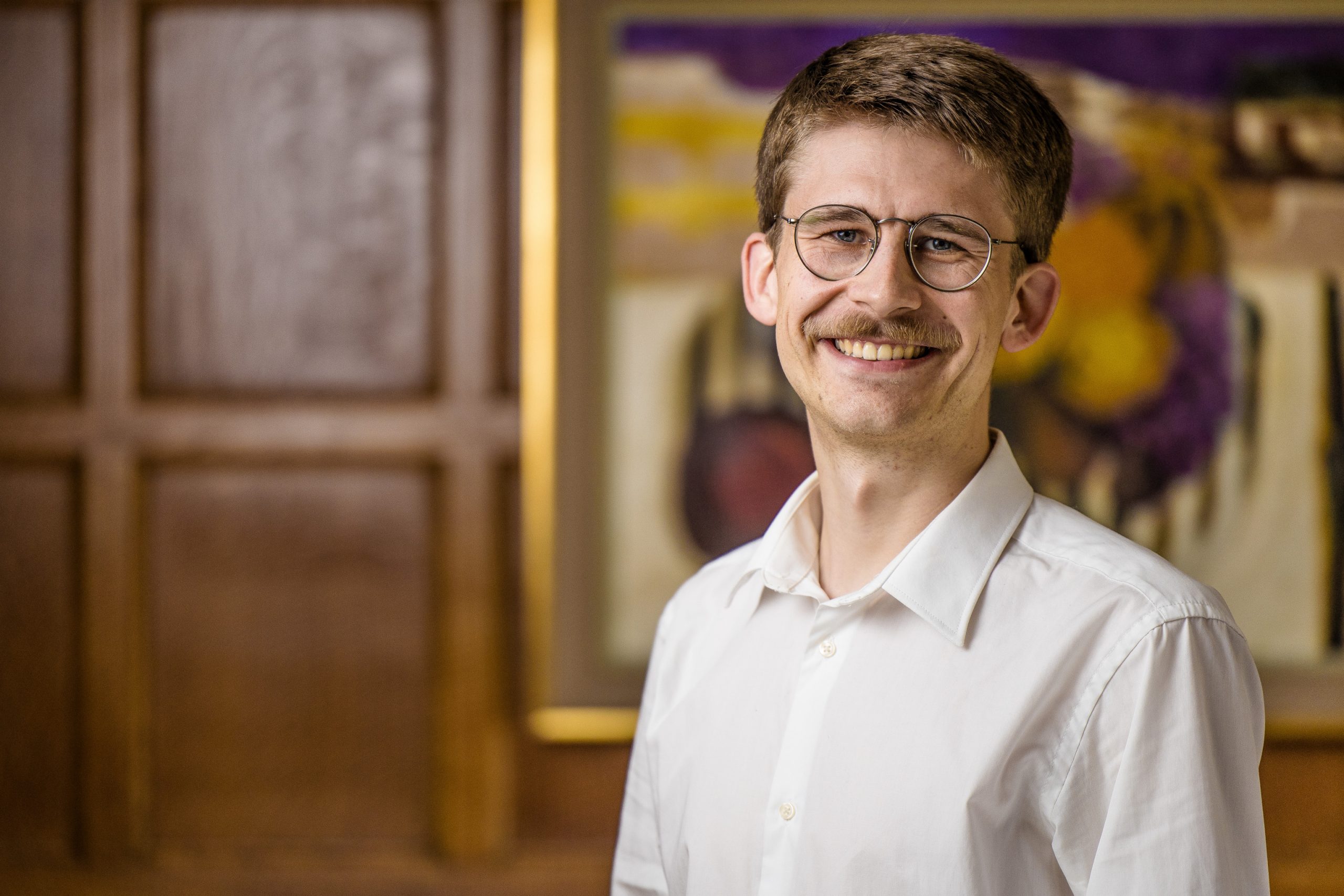
AS Dissertation Award 2025
Dr. Kasimir Dederichs (University of Oxford, Nuffield College) has been awarded the 2024/25 Dissertation Award by the Academy of Sociology. The award recognizes his dissertation, “Who (Else) Is Involved? How Voluntary Associations Connect and Separate Us.” The jury—Ben Jann (University of Bern), Gunnar Otte (University of Mainz), Peter Preisendörfer (University of Mainz), and Anina Schwarzenbach (University of Bern)—commended the theoretically original and methodologically rigorous approach, which examines the entire life cycle of association memberships. Parts of the comprehensive dissertation have been published in international, peer-reviewed journals, including Gender & Society, Social Networks und European Sociological Review.
In his dissertation, Dederichs examines the extent to which associations and other civil society organizations—as is often assumed in macro-level analyses of social cohesion—promote contact between people from different social groups. He analyzes how homophilic tendencies in the decision to join an organization (front door), in the social dynamics within organizations (indoors), and in the decision to leave (back door) give rise to patterns of social segregation between and within organizations. His empirical analyses are based on panel surveys from Germany and the Netherlands.
Key findings:
1. Civil society is segregated by gender. Women and men get involved in organizations that align with traditional gender roles and “extend” those roles beyond the private sphere. Gender-homogeneous friendship networks are associated with a higher likelihood of joining organizations in which one’s own gender is predominantly represented. (Link: https://doi.org/10.1093/esr/jcac013)
2. People who are active in organizations have larger social networks. This is due, on the one hand, to the fact that people with stronger social networks are more likely to join associations, and, on the other hand, to the fact that new members continue to expand their networks. However, due to socioeconomic disparities in participation, associations do not necessarily contribute overall to reducing inequalities in access to (high-status) social capital. (Link: https://doi.org/10.1016/j.socnet.2023.07.004)
3. In addition to the ethnic segregation observed among clubs, the patterns of social interaction within these organizations are often segregated as well. People without an immigrant background form fewer social connections in ethnically diverse clubs and are also more likely to leave these clubs. (Link: https://doi.org/10.1093/esr/jcae047)
4. Socioeconomic inequalities in participation in organizations decrease during the transition from early adolescence to adulthood. One reason for this is that adolescents from higher-status families are more likely to pursue higher education, which then leads them to discontinue their participation in clubs. Nevertheless, even among young adults, those from higher-status families are more likely to be actively involved. (Link: https://doi.org/10.1093/esr/jcac013)
Conclusion: Due to sorting processes, clubs do not automatically serve as places that bridge socially salient divides. Additional measures are therefore necessary to fully realize the integration potential of clubs.
Short biography: Kasimir Dederichs is a Postdoctoral Prize Research Fellow in Sociology at Nuffield College, University of Oxford, where he earned his Ph.D. from 2020 to 2024. Prior to that, he studied sociology and empirical social research (Master’s) as well as social sciences (Bachelor’s) in Cologne. In his current research, he examines social integration in the context of clubs, neighborhoods, and couple relationships.
Quote from the award winner: “I am very pleased to receive the Best Dissertation Award and would like to take this opportunity to thank the Academy of Sociology and my doctoral advisor, Nan Dirk de Graaf.”